



Iran targets privacy apps during internet blackout
'Privacy tools threaten governments,' says expert, as NetBlocks estimates shutdowns cost Iran about $37 million per day


Iran is blocking the encrypted messaging app Session during an ongoing internet blackout, using DNS spoofing to stop downloads.
During periods of political unrest, privacy tools threaten governments by denying them surveillance and control over communications, as apps that operate on distributed ledgers “limit state control by resisting takedowns and making it harder to dominate narratives during political unrest,” Nishant Shah, Faculty Associate at Berkman Klein Center at Harvard University, told The Crypto Radio.
“In shutdowns, the goal isn’t to stop information entirely, but to slow it, fragment audiences, and push people into channels that are easier to monitor or manipulate,” Shah added, who is also Professor of Global Media & Culture at The Chinese University of Hong Kong.
Unlike mainstream messaging platforms that can be compelled to cooperate with authorities or share user data, privacy-focused apps are designed to limit surveillance by default. In Session’s case, that privacy is reinforced by its decentralized design, which removes central servers that could be pressured or shut down.
“Decentralized apps like Session have no central servers that can expose user data or target users,” Alexander Linton, Session Technology Foundation President, told The Crypto Radio.
Session is a privacy-focused messaging app increasingly targeted by governments during internet shutdowns and network-level censorship. Photo: Session
Session remains blocked for 27 consecutive days, according to a report by Whisper Security. And this isn’t the first blackout.
In June 2025, Iran imposed a nationwide shutdown during the Iran-Israel conflict, cutting connectivity by 97% and later using “stealth” blocks like DNS poisoning and throttling.
In other countries such as Nepal, Signal and Telegram were blocked alongside major platforms during youth-led anti-corruption protests.
In Russia, authorities have blocked apps like Signal, Viber, Discord, and SimpleX Chat since August 2024, citing non-compliance with data laws, according to a report by Human Rights Watch.
How censorship is enforced
Because privacy apps cannot be easily monitored or forced to share data, governments increasingly rely on network-level censorship tools to block access altogether. One of the most common methods is DNS spoofing, which redirects or disrupts connections before users ever reach the app.
Linton explained how DNS spoofing works best in targeted bursts. “Over time users find workarounds, but the biggest impact comes early, when people are misdirected to fake sites or cut off from critical services.”
In response, some developers are experimenting with alternative systems that aim to bypass traditional DNS entirely. In some cases, Linton highlighted, “blockchain-based naming systems like ENS could offer censorship-resistant alternatives to DNS, but they are not yet widely adopted or fully viable.”
“These systems better resist DNS spoofing, but slow speeds and low adoption make them impractical for now,” said Linton.
“Enforcement is also uneven, people adapt, and once manipulation is expected, trust erodes across the wider information environment,” said Shah. “[Blockchain-based naming systems] reduce some control points but aren’t a cure-all – states can still pressure ISPs, throttle traffic, criminalize use, or spread disinformation, while blockchain naming brings its own governance, security, and accessibility risks.”
The economic cost of going offline
Internet shutdowns are costly. “NetBlocks estimates a full shutdown costs Iran about $37M per day, making January’s unprecedented outage an unsustainable burden,” said Linton.
“Not all censorship is equal," he added. "Targeted blocks such as whitelisting limit access [by restricting users to a small set of government-approved websites], but stopping resistant tools usually requires a full internet shutdown.”
“These shutdowns can also suppress future economic activity due to extremely hostile in-country conditions,” he said.
“Even when framed as blocking protests, shutdowns quickly cause wider harm – disrupting payments, work, health access, and daily life, making staying connected costly and exhausting,” Shah agreed.
Groups such as Amnesty International and Access Now “expose internet shutdowns as human rights violations, highlighting their severe economic impact and the resulting diplomatic and reputational costs,” said Linton.
“[The groups] matter less as enforcers and more for documenting abuses, challenging narratives, and raising the political cost of normalizing shutdowns as rights violations,” said Shah.
How users find ways around blocks
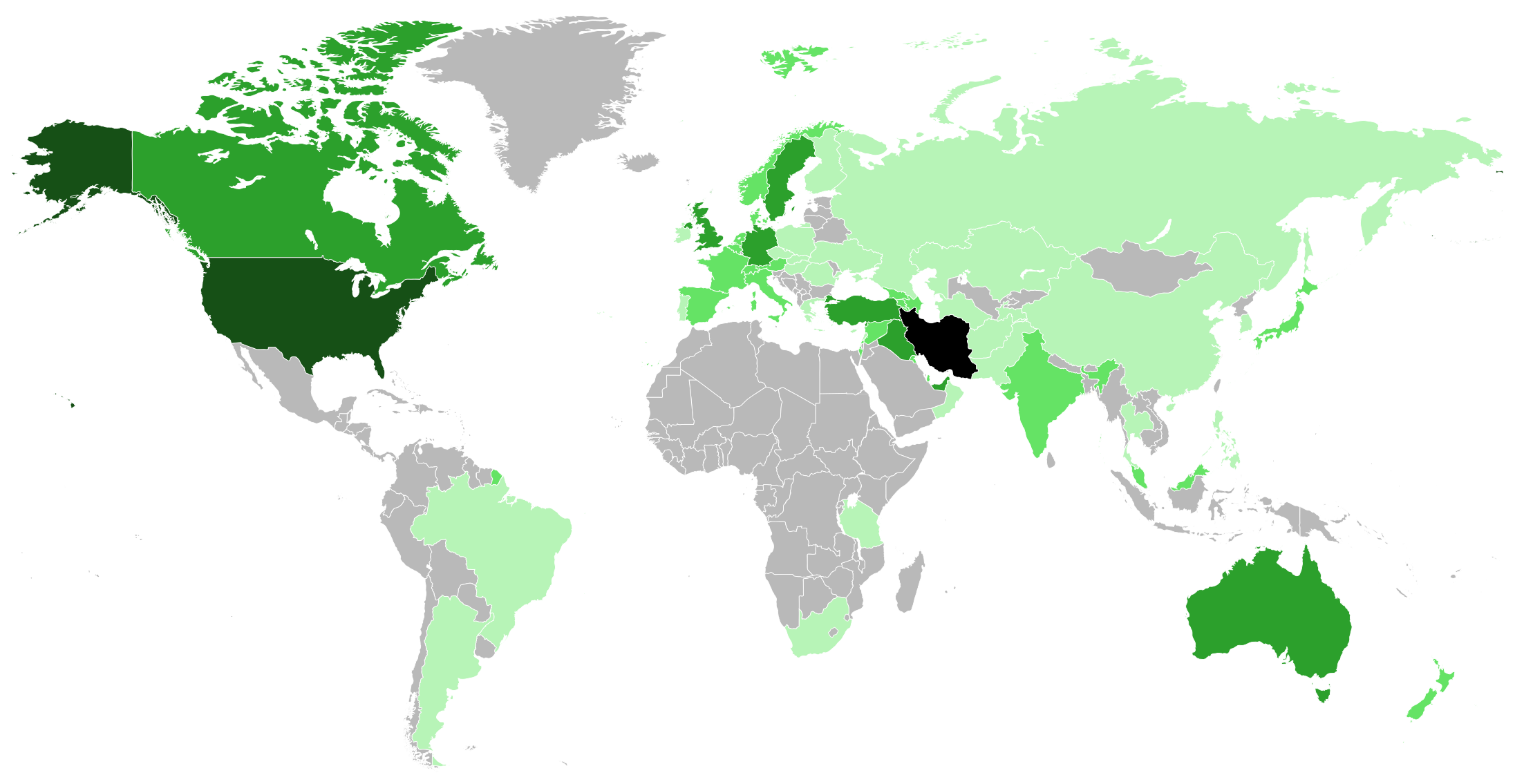
Across borders, Iranian communities help circulate guidance, proxies, and secure tools to bypass digital restrictions and censorship. Photo: Wikimedia Commons
Despite internet blockades, people still try to find ways to bypass them.
“Shutdowns are usually leaky, not total. People rely on shared access, social networks, partial connectivity, and mixing digital workarounds with offline channels and traditional media,” Shah said.
The Iranian diaspora and activist community “do an incredible job at helping keep people connected by sharing circumvention tools, encrypted guidance, and running or teaching others to run proxies,” Linton noted.
“The international response works like a relay, with diaspora networks, media, rights groups, and tech communities passing information across borders and back in low-bandwidth, resilient forms,” Shah agreed.
An ongoing arms race
As governments increasingly restrict access to online platforms, a key question is how privacy apps evolve to stay ahead of state control.
“Apps are becoming more censorship-resistant, but the exact methods are hard to detail due to an ongoing arms race between developers and censors,” Linton said.
“The trend is to design for hostile networks. Expect blocks and interference – using redundancy and decentralization, often trading ease-of-use for resilience, which affects who can use these tools under pressure,” Shah said.
Past internet shutdowns show that information blackouts are rarely total or static and often produce outcomes governments do not fully control. Instead, they create uneven conditions that shape both repression and resistance.
Shah highlighted how “that unevenness fuels both repression and resistance. Shutdowns often worsen misinformation by removing verification, and once app-specific blocks are normalized, they tend to expand rather than stop.”
Regardless, even when “censors learn from each other, making shutdowns more frequent and aggressive, the public is also adapting – seen in growing use of tools like mesh networking apps,” Linton said.