




Knut Svanholm: Living freely in the inverse of clown world
'Every single Satoshi that exists is just someone keeping a secret from everyone else,' says the author and podcaster

What does it mean to live in the inverse of ‘clown world’?
For Knut Svanholm, the answer begins with money – specifically, the rules that quietly shape behavior across entire societies. “It’s about how everything on a Bitcoin standard is literally the inverse of how it is on a Fiat standard,” he told Guardians of Bitcoin.
From that inversion flows a critique not just of modern finance, but of politics, incentives, ownership, and power itself.
Svanholm, a Swedish author and longstanding voice in the Bitcoin community, sees today’s dominant monetary system as a distorted mirror – one that rewards proximity to power over merit, quantity over quality, and short-term gains over long-term responsibility. Bitcoin, in his view, flips those incentives on their head.
From ‘clown world’ to broken money
When Svanholm talks about “clown world,” he isn't pointing to culture or aesthetics, but to outcomes. In his view, fiat money quietly reshapes behavior by constantly losing value. “Fiat currencies are inflationary, meaning that people more and more prioritize quantity over quality and political connections, instead of excellence,” he said.
Inflation, in this framing, is not just rising prices but a moral hazard. When money steadily depreciates, saving becomes irrational and consumption accelerates. By contrast, Svanholm describes Bitcoin as structurally deflationary.– "Because it’s absolutely finite,” he said.
That scarcity, he argued, changed how decisions were made. “If things get cheaper, we buy more of them,” he said, pushing back on the idea that deflation was inherently harmful. “You will think twice before you choose to buy anything, meaning that you will prioritize quality over quantity. And I think this is a very beautiful thing.”
For Svanholm, fiat money was not a neutral tool but an extractive one. “Fiat money is created by banks and governments. They have a license to counterfeit your money, which is theft, straight up like this.” He did not soften the claim. “It is theft, and it’s on a massive scale.”
Politics without merit
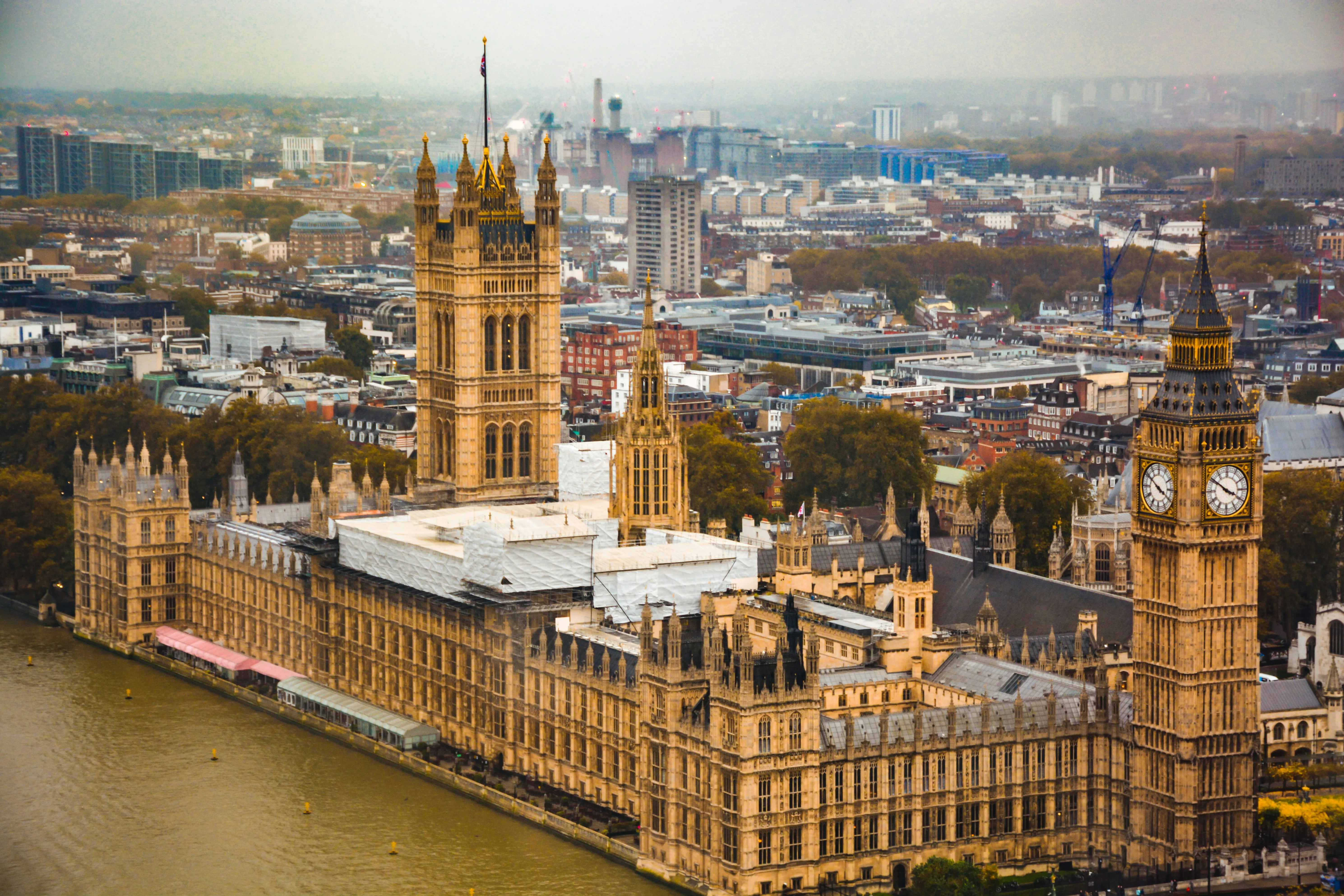
The UK parliament, a central institution within a democratic system shaped by policy, power, and incentives. Photo: Unsplash / Paul Silvan
That same incentive distortion, Svanholm argued, extends beyond money into politics. In his telling, “the clowns” are politicians operating in systems that reward popularity and signaling rather than competence. “Things get very clownish, when merit is not rewarded, but political connections and virtue signaling becomes more and more important,” he said.
Democracy, as practiced today, in his view incentivizes short-term appeasement. Politicians, he argued, do “what you think people want in order to get votes,” rather than what serves long-term societal health. While acknowledging that conditions differed between countries, he pointed to recurring patterns. “The UK is a bit of a mess at the moment,” he said, describing rising costs and social unrest as symptoms rather than isolated failures.
His critique extended to taxation itself. “All taxes are involuntary, we live under gun threat,” he said. “Our property is taken away from us, and we cheer for it, because we think it comes to good use.” What remains unknown, in his view, is what societies might look like under genuine market coordination rather than permanent intervention.
Property, speech, and incentives
The same logic, Svanholm argued, applies to rights. Observing migration patterns, he pointed to the UAE as an example of revealed preference. “People still choose to move to UAE because of lower taxes,” he said, despite more limited speech protections. “By their actions, they show that they prioritize property rights over freedom of speech laws.”
Drawing on philosopher Murray Rothbard, he added, “Freedom of speech is only necessary where a property violation has happened before in a so called public space.” The statement is deliberately provocative, but the argument remains rooted in incentives. Systems protect what they economically value.
That view carries over into the digital realm. “If I own a social media platform, and I want it to be successful, I have an incentive to care about freedom of speech,” he said. Market pressure, not regulation, ultimately determine openness.
Disagreements inside Bitcoin
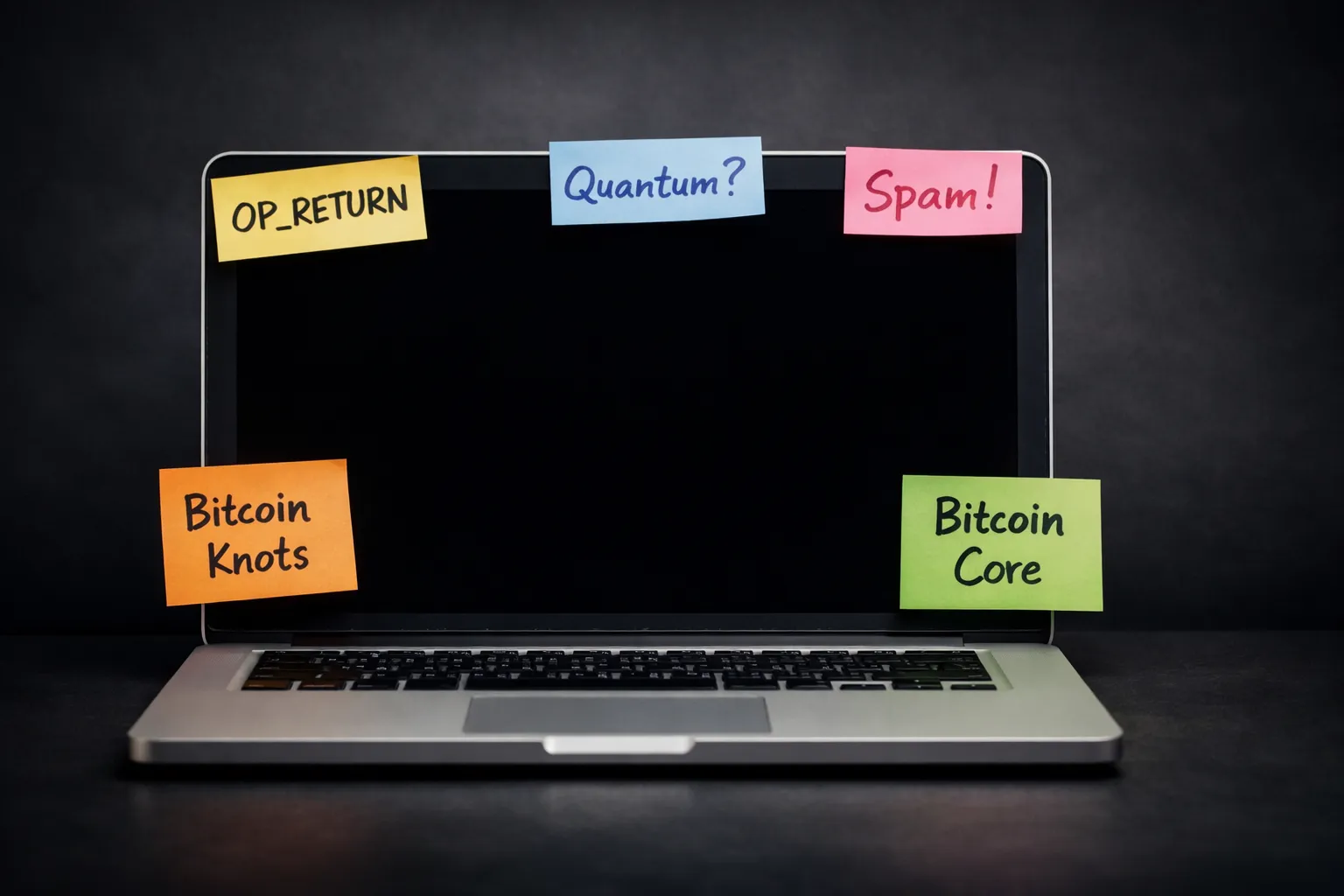
Bitcoin Core debates show how rules, incentives, and trade-offs are contested in a decentralized system
Svanholm rejected the idea that Bitcoin itself is free of conflict. In fact, he sees disagreement as essential. Without leaders, the system advances through argument. “That’s what happens in a leaderless system," he said. "There is no authority here that can decide this or that.”
One ongoing debate concerns whether Bitcoin should allow more non-financial data to be stored on its blockchain. Expanding a feature known as OP_RETURN could theoretically enable spam or even illegal content. “If you increase OP_RETURN too much you could potentially store a small video in it and stuff and really nasty stuff that no one wants to see,” he said.
At the same time, he acknowledged that such abuses were already possible. “You can do that now. You will still be able do that in the future too.” The disagreement, he argued, was not about perfection but trade-offs.
What worries him more is imbalance within the community. “You have the more 180 IQ Silicon Valley types that are often very technically competent [but] are not as economically literate,” he said. “You want Bitcoiners to be both technical and economically literate.”
Bitcoin, ownership, and a gradual shift
For Svanholm, Bitcoin is as much culture as code. His own path led him into writing, publishing, and even music as ways to process its impact.
He helps run a Bitcoin-focused publishing company in Estonia and plays in the band Toshiro Moto, arguing that entertainment and humor are part of spreading ideas. “If the audience is not entertained, they won’t care,” he said.
Philosophically, his most distinctive claim concerns what it means to own Bitcoin. “Every single Satoshi that exists is just someone keeping a secret from everyone else,” he said. “The ability to move [Bitcoin] is strictly in your head.” Because ownership rests on information rather than institutions, he argued, it “changed the profitability of violence,” making coercion less effective over time.
Svanholm expects change to be gradual, likening Bitcoin to a new language of value. Ultimately, he said, “the real currency of the future is integrity and your reputation. Honesty and sincerity will be rewarded more and more.”