




What it really takes to get hired in Bitcoin
Remote roles fall 10% in 2025 as hiring becomes more selective and increasingly network-driven, according to Bitvocation data


The Bitcoin job market is growing – and growing up.
Job listings are up and interest from job seekers is surging, yet companies are becoming more selective, remote roles are declining, and expectations around execution and Bitcoin alignment are rising. The data points to a market that is no longer defined by experimentation alone, but by maturing norms around how Bitcoin companies hire and operate.
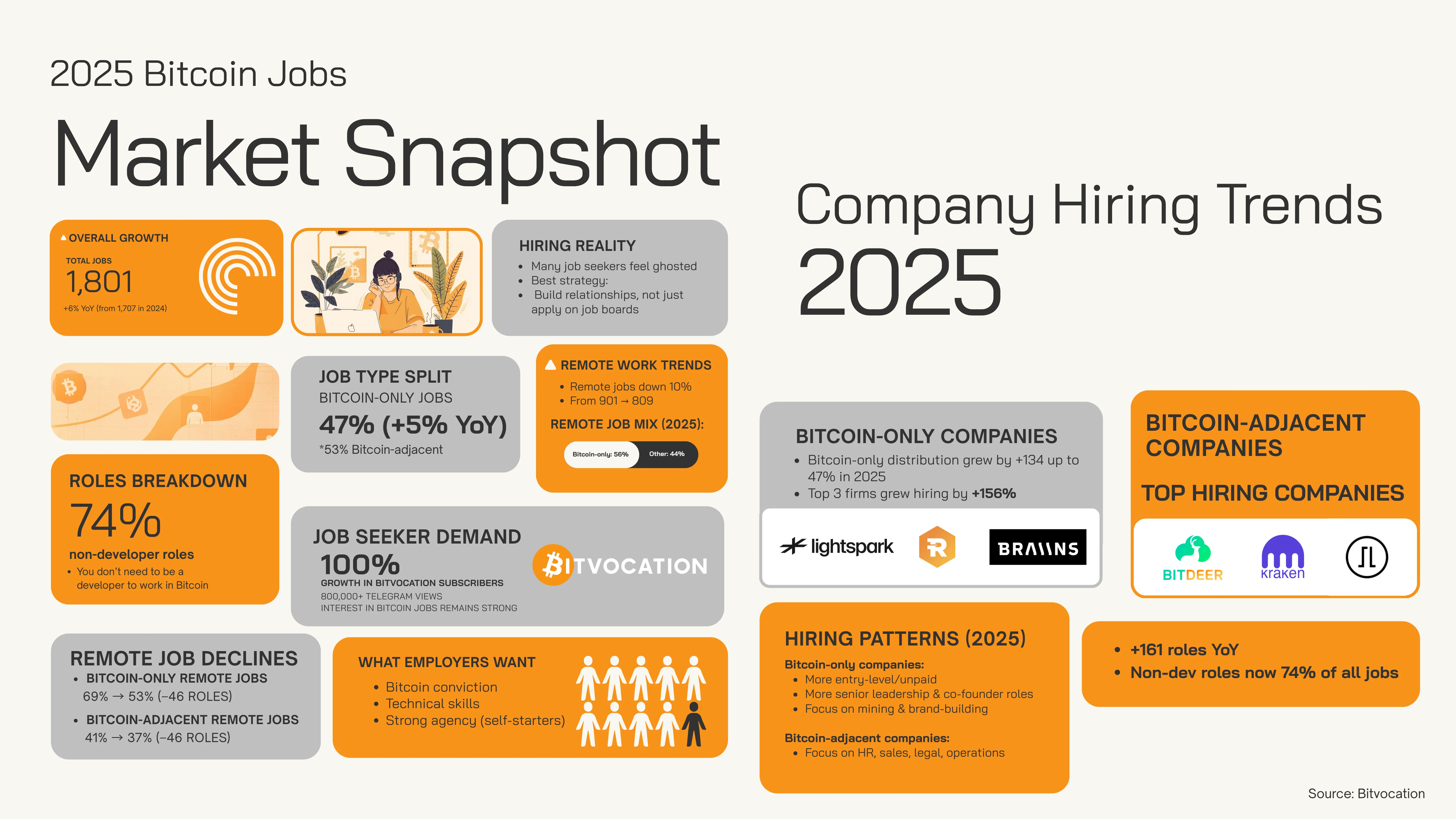
Bitvocation’s Bitcoin Job Market Report 2025 shows interest in Bitcoin-related jobs remained strong throughout the year. The company recorded a 100% increase in subscribers actively seeking Bitcoin roles, while its Telegram job feed drew more than 800,000 views.
That demand translated into steady, if moderate, hiring growth, with total Bitcoin-related job listings rising to 1,801 in 2025, up 6% from 1,707 the year before. While not explosive, that increase stands out against a backdrop of broader tech-sector uncertainty and signals continued confidence in Bitcoin-focused businesses.
At the same time, the nature of available roles continues to evolve. Non-developer positions now account for 74% of all Bitcoin job listings, reinforcing that working in Bitcoin increasingly means applying operational, creative, or commercial skills rather than purely technical ones.
Bitcoin-only companies also expanded their share of hiring, accounting for 47% of all roles in 2025, up five percentage points year-on-year, while Bitcoin-adjacent positions declined slightly.
Remote work pulls back
Despite Bitcoin’s long association with globally distributed teams, remote work became less common in 2025. The number of fully remote Bitcoin roles fell by 10%, dropping from 901 to 809. While Bitcoin-only companies still favor remote setups more than Bitcoin-adjacent firms, the overall direction points toward hybrid and location-based models becoming the norm.
This shift suggests that as Bitcoin companies mature, many are prioritizing closer collaboration and faster execution over fully decentralized work structures. What was once a defining feature of the industry is increasingly giving way to more conventional organizational models, particularly among larger and better-capitalized firms.
'Ghosting Economy'
Alongside these structural changes, job seekers report a more frustrating hiring experience. Bitvocation’s report highlights recurring feedback from candidates who describe applying into a “ghosting economy,” where applications go unanswered and feedback is scarce.
Bitvocation’s POW Lab member, Miguel Abascal, discovered this recurring theme amongst job-seeking Bitcoin professionals through a Bitcoin job seekers survey, which he called “a sense of applying into a ‘Ghost economy,’” where automated filters replace human judgement and strong candidates struggle to be seen.
Employers see a different bottleneck
From the employer perspective, the challenge looks very different. In a small qualitative survey of fewer than 20 Bitcoin companies, respondents consistently said hiring was constrained not by a lack of applicants, but by a shortage of candidates who combine professional competence with genuine Bitcoin understanding.
The hardest roles to fill clustered at two ends of the spectrum. Highly specialized technical positions, including Bitcoin Core, Lightning, and security roles, remain scarce. At the same time, non-technical roles that require translating Bitcoin’s values into product, operations, growth, or communications are equally difficult to staff. The result is a clear tension between supply and suitability.
How Bitcoin companies choose talent
Against this backdrop of tighter hiring channels and changing work models, growth is becoming more concentrated among a smaller group of employers. The report found that the top nine Bitcoin companies expanded their hiring by 156% in 2025, led by Riot Platforms, Lightspark, and Braiins. Meanwhile, among Bitcoin-adjacent firms, Bitdeer, Kraken, and SatoshiLabs posted the highest number of job openings during the year.
Building on the surge in interest highlighted earlier, the report also clarifies what qualifies as a Bitcoin company. It defines these firms as those offering Bitcoin-only products (not broader crypto services), publicly committing to a Bitcoin-only focus, and actively contributing to Bitcoin development, open-source projects, or the wider Bitcoin community.
Across survey responses, employers emphasized that technical ability alone is no longer enough. Strong communication, an ownership mindset, and the ability to operate in small, fast-moving teams matter as much as formal skills. AI literacy is increasingly expected, but rarely sufficient on its own.
Candidates who stand out are those who can map existing skills in areas such as operations, compliance, sales, or marketing into a Bitcoin-native context, while continuing to build technical understanding around areas like Lightning or protocol development. Early-stage startups, in particular, value people who can wear multiple hats and execute in messy, real-world environments.